


Causa is one of those Peruvian dishes whose history is bound up with popular stories passed down from generation to generation.
According to one of the stories told in Peru, during the War of the Pacific at the end of the 19th century, women prepared and sold potato-based dishes to raise money to support the soldiers and their families. These preparations are said to have been sold “por la causa” — “for the cause”, an expression that would thus have given the dish its name.
But as is often the case with old recipes, the story is not that simple. Another tradition places the origin of the name at the time of Peru’s independence, while some link the word causa to the Quechua kawsay, associated with life and sustenance.
It is therefore impossible to attribute the birth of causa to a single period with any certainty. Its history lies somewhere between popular tradition, collective memory and culinary heritage.
What is certain, on the other hand, is that causa has become one of the great classics of Peruvian cooking.
Causa rellena is made from a cold potato purée, brightened with lime and fresh ají amarillo. The sweetness of the potato, the acidity of the lime and the fruity character of the ají amarillo form a combination full of freshness and flavour.
The classic versions are filled with chicken, tuna or vegetables.
Today, with the remarkable creativity of Peruvian gastronomy, causa comes in a thousand forms: octopus, scallops, seafood and many others.
At home, our classic has always been causa with shredded chicken, celery and homemade mayonnaise. But over time another version became my favourite: causa with crab meat and pink sauce.
I usually keep it for special occasions. It takes a little time and patience, but when it arrives at the table it is well worth the effort.
Causa with crab meat
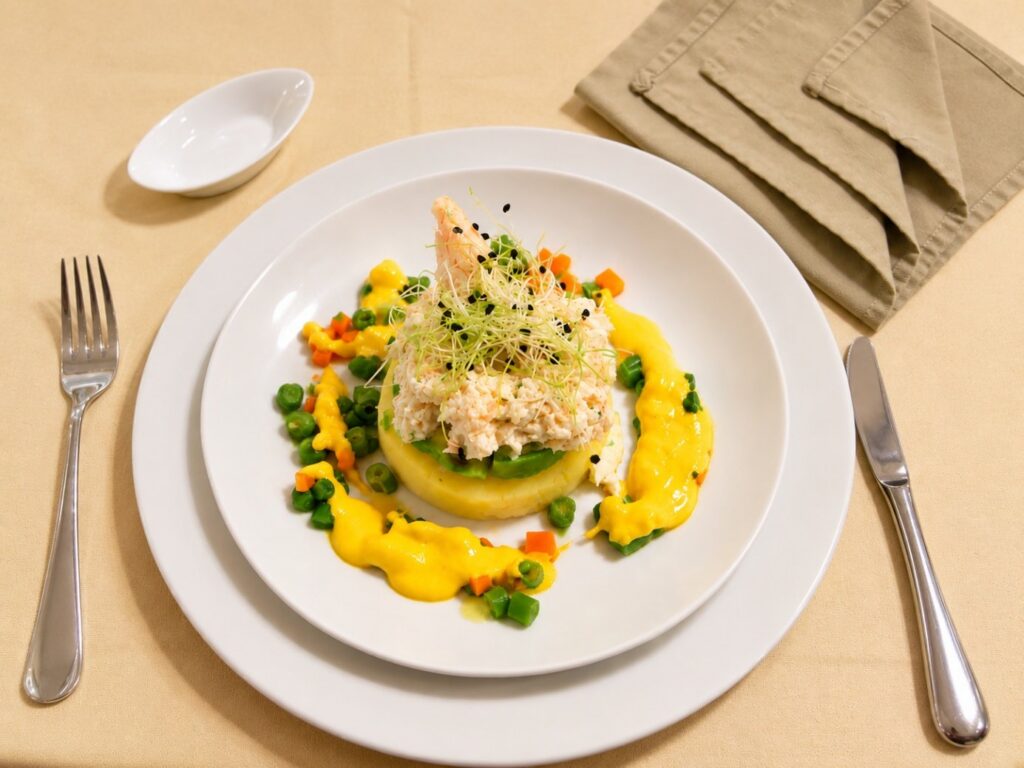
Here is my version of causa rellena.
Ingredients
For the causa
- 1.5 kg floury potatoes
- 3 limes
- 2 tbsp purée of fresh raw ají amarillo, deseeded and stripped of its inner membranes
- 1 tbsp purée of fresh raw ají amarillo, blended with its seeds and membranes, for a hotter touch
- 6 tbsp vegetable oil or a light-tasting olive oil
- 1/2 tsp salt
- 1/4 tsp pepper
For the filling
- 500 g crab meat
- 4 hard-boiled eggs
- 8 tbsp homemade mayonnaise
- 2 to 3 tbsp ketchup
- Salt and pepper
- 120 g onion sprouts
To serve alongside
- 2 large avocados
- 150 g cooked green beans, cut into small pieces
- 100 g cooked carrots, cut into small dice
For the two ají amarillo sauces
- 4 fresh raw ají amarillo
- 1 small piece of onion
- Olive oil
- Salt
Method
Making the two ají amarillo purées
Start by preparing two versions of ají amarillo, both from fresh raw chillies.
For the mild version, carefully remove the seeds and the inner membranes from the ají amarillo. Cut the flesh into pieces and blend until you have a smooth purée.
For the hot version, keep the seeds and the inner membranes before blending the chillies. This purée will naturally be far hotter.
These two preparations will be used to season the causa: the first will bring the aroma and the fruity flavour that are characteristic of ají amarillo, while the second will let you adjust the heat to your taste.
Set the two preparations aside separately.
Making the causa
Cook the potatoes in water until tender. Drain them, peel them, then put them through a potato ricer while they are still hot.
Let the purée cool for a few minutes. Once it is no longer piping hot, work it with perfectly clean hands.
Add 2 tbsp of ají amarillo purée without seeds or membranes, then 1 tbsp of the hotter version.
Add the salt and the pepper, then gradually work in the oil and the lime juice.
Work the mixture gently until you have a smooth, supple dough. Taste and adjust the seasoning if needed, in particular by adding a little hot ají amarillo purée if you would like a spicier causa.
The dough must be firm enough to be shaped. It should be neither sticky nor elastic and should not stay on your hands.
Keep it in the fridge for about 30 minutes.
Making the crab filling
In a bowl, mix the crab meat with the hard-boiled eggs cut into very small dice.
Add a little salt and pepper, then the homemade mayonnaise and 2 to 3 tbsp of ketchup.
Mix gently until smooth, then keep in the fridge.
Making the ají amarillo sauces to serve alongside
Use the ají amarillo purées made earlier to produce two sauces: one mild and one hot.
For each of them, blend the ají amarillo purée with a little raw onion, a pinch of salt and a drizzle of olive oil.
Add the oil gradually until you have a smooth, slightly creamy sauce.
The first sauce, made without seeds or membranes, will be milder and will let you fully enjoy the fruity aroma of the ají amarillo.
The second, made with the seeds and the membranes, will be far hotter. Serve it in small quantity so that everyone can adjust the heat to their taste.
Keep the two sauces separately in the fridge until serving.
Assembling
For a classic, even presentation, the best option is to use a plating ring, like those used for steak tartare.
Place a first layer of causa in the bottom of the ring. Add a thin layer of avocado, then a generous layer of crab filling.
Finish with a slightly thinner layer of causa and place a few onion sprouts on top.
Carefully remove the plating ring.
My presentation
For the causa I am showing here, I did not use a plating ring.
I simply shaped a small nest of causa by hand, roughly the size of the palm of my hand. I then arranged a thin layer of avocado, then a generous portion of crab filling and, to finish, a few onion sprouts.
Around the causa, I arranged the small pieces of green bean and the diced carrot, then added a few touches of mild ají amarillo sauce.
The hotter sauce can be served separately, in a small dish, so that everyone can add it to their taste.
A word before you start
Causa is not a particularly difficult dish, but its preparation and above all its plating take a little time and practice. The result is well worth the effort: it is a delicious dish that I especially like to make for special occasions.
Enjoy!
Leave a Reply